Overview
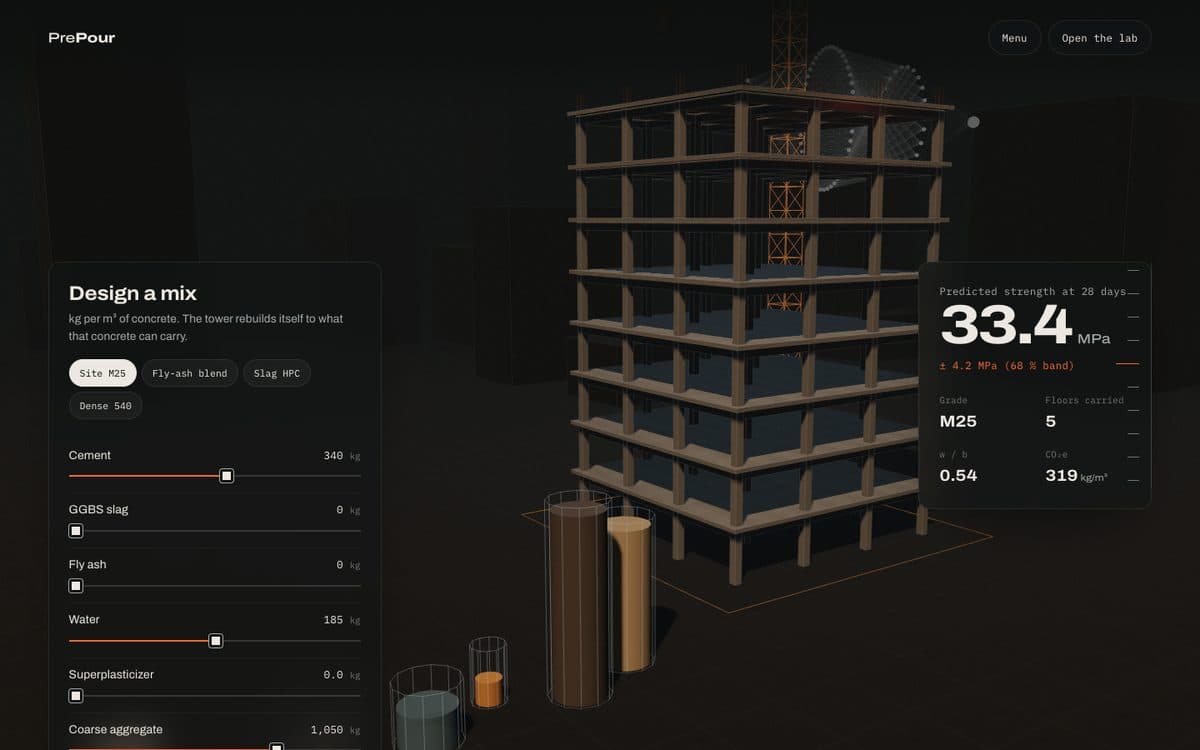
An interactive 3D web app that predicts concrete's compressive strength from its mix design and age, then interprets the result the way a site engineer would.
The problem
Concrete strength is only confirmed by the 28-day cube test, after floors are already built on it, so mixes carry extra cement to be safe. That costs money and adds CO₂.
How it works
The model is an ensemble of five small neural networks trained on 1,030 lab specimens from the UCI concrete dataset. Its weights are exported to the site and every prediction runs in the browser.
Each forecast comes with an uncertainty band, then gets interpreted against Indian Standards: the achievable grade from IS 10262, an IS 456 durability check, a strength-over-time curve, a sensitivity chart, and how many floors a column could carry. The 3D tower on the page rebuilds to that height.
A green-mix search streams 3,600 candidate mixes into a CO₂-versus-strength plot to find leaner mixes that keep the predicted 28-day strength.
What it does
- Strength prediction from 7 mix ingredients and age
- Uncertainty band on every forecast
- IS 10262 grade and IS 456 durability check
- Strength-age curve and sensitivity chart
- Column capacity, shown as a 3D tower
- Lower-CO₂ mix search
Built with
- Three.js
- JavaScript
- Python
- scikit-learn
- Neural network ensemble
In numbers
R² 0.936 on held-out test data (RMSE 4.12 MPa), against 0.638 for a linear baseline
Try it live
The live version opens in a new tab, so you can explore it at full size.
Open PrePour ↗